Meet Monarch Park Community Trust
Monarch Park Community Trust has been a fixture of East York's arts and culture scene for fifteen years. With a small but dedicated team of thirty staff, they run heritage programming, community arts education, and neighbourhood events that draw hundreds of residents every year.
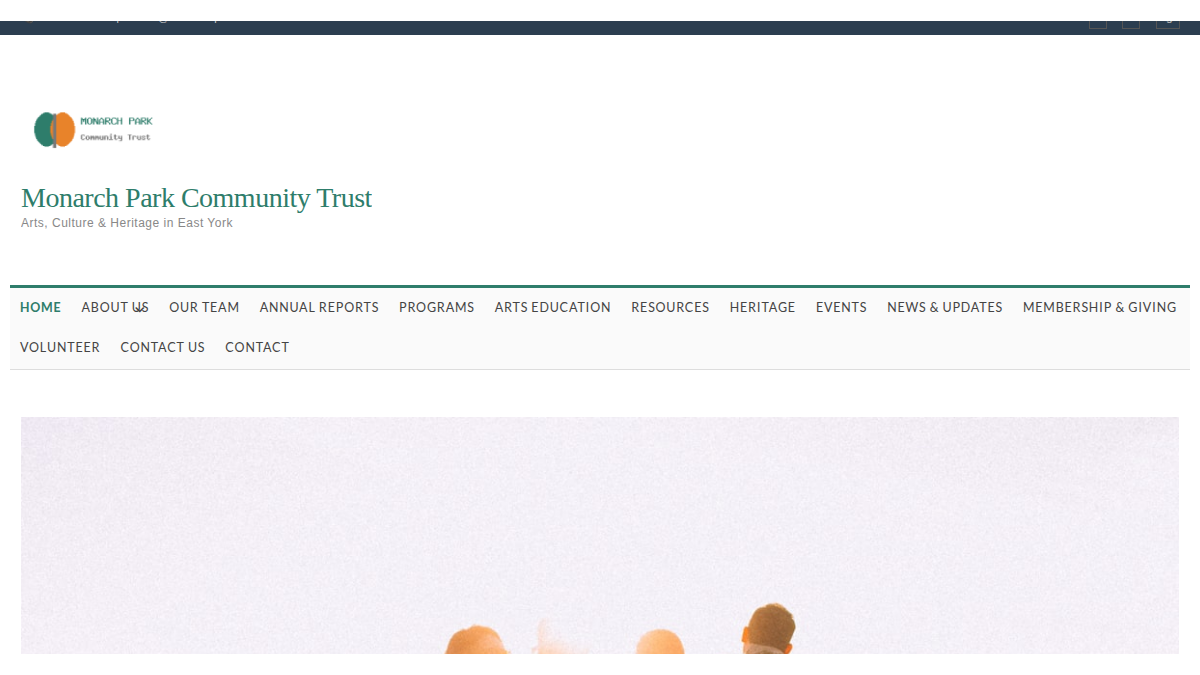
Like most Canadian non-profits their size, they built their website on WordPress around 2015. At the time it made sense. WordPress was everywhere, volunteers knew it, and it was cheap to set up. A local agency built the theme, added a handful of plugins, and handed over the keys.
For a few years it worked well enough.
By 2026 it was a different story.
The Slow Accumulation of Problems
Nobody at Monarch Park could point to a single moment when the website stopped working for them. It happened gradually, the way most technical debt accumulates. One plugin update at a time. One workaround built on top of another. One staff member who knew how things worked leaving and taking that knowledge with them.
By the time their new Communications Manager, Sarah, joined in early 2025, the site had become a source of daily frustration rather than a functional tool.
The Events page still showed programs from two summers ago. The homepage slider, a relic of a design trend that peaked around 2014, cycled through three slides. One of them still promoted a grant application deadline that had long since passed. The donation page linked out to an external CanadaHelps page because nobody had ever figured out how to integrate giving directly into the site.
Worse, the site was slow. A Google PageSpeed score of 43 on mobile. An eleven-second load time on a decent connection. Images that had never been compressed, uploaded at full resolution by well-meaning staff over a decade of updates.
And then there was the accessibility audit.
A volunteer with a background in web development ran the site through an automated checker and came back with 53 WCAG 2.1 AA violations. Contrast failures on the teal navigation. Images missing alt text throughout. Form fields with no accessible labels. For an organization whose programs serve seniors, newcomers, and community members with disabilities, this was more than a technical problem. It was a values problem.
The Conversation Every Non-Profit Dreads
Sarah brought the findings to the Executive Director, James, in a meeting neither of them was looking forward to.
The site needed more than a refresh. It needed a rebuild.
The question was what to rebuild it on.
WordPress was the obvious answer. It was what they knew, what their board recognized, and what most agencies would quote them on without blinking. But Sarah had done enough research to know that rebuilding on WordPress meant inheriting the same fundamental limitations in a newer package. More plugins. More maintenance. More dependency on a developer every time something needed to change that wasn't covered by the page builder.
She had started reading about alternatives. Contentful. Sanity. And something newer called Payload.
A Quick Note on Payload
If WordPress is the tool your communications team uses to update your website, Payload is the engine running underneath a new kind of website. One that gives your team the same easy content editing experience, but gives your developers far more control over how everything is built and maintained.
Unlike WordPress, which relies on a sprawling ecosystem of plugins that need constant updating and can conflict with each other, Payload is built as a single cohesive system. There are no plugins to manage, no licensing fees, and no vendor lock-in. You own your data and your codebase entirely.
For non-technical staff, it looks like a clean, modern dashboard where you update text, upload images, and publish pages. Not unlike what you might already be used to in WordPress. For developers, it means fewer headaches, less maintenance overhead, and code they actually control.
It is also worth noting that Payload was acquired by Figma in June 2025. The product remains fully open source and nothing has changed for existing users. If anything, the acquisition signals that Payload is being taken seriously at an enterprise level, which is good news for organizations making a long-term investment in the platform.
Why This Story Sounds Familiar
If you work at a Canadian non-profit and read that description of Monarch Park's website situation with a sense of recognition, you are not alone.
The pattern is remarkably consistent across organizations of this size. WordPress installed between 2012 and 2017. A theme that made sense at the time. A plugin stack that grew organically to solve problems as they arose. Staff turnover that eroded institutional knowledge. And a site that now costs more to maintain than it delivers in value.
The question Sarah and James faced is the same question Communications Managers and Executive Directors across the country are asking right now.
Is there a better way?
What's Next
Over the next several posts we are going to follow Monarch Park Community Trust through their website rebuild process, from evaluating CMS options to making the case to their board, through to what a Payload-based solution actually looks like in practice for an organization their size.
In the next post we will look at what Sarah found when she started evaluating WordPress alternatives, and why Payload ended up on the shortlist alongside more established options.
This is Part 1 of a series. Follow along as we walk through the full migration from WordPress to Payload for a fictional Canadian non-profit. Get in touch if your organization is facing a similar decision.